Just published: My Three Suicides: A Success Story...

Wednesday, August 5, 2015

Politics 2016: Yes, Virginia, there is no Aunt Jemima, Betty Crocker nor John E. Hollister

 Woe and double woe, as William Wordsworth used to say after a hard day of daffodil worship. “The world is too much with us; late and soon,” he’d add, watching his shot glass sink into his beer mug. Mumble, mumble, mutter-mutter, then stumble home from the pub for succor from this dissembling world. Small wonder he turned away from human commerce and sought the world of nature, where things always are what they seem to be.
            
(Except for Angler fish, one must admit, they whose tongues look like worms to unsuspecting smaller fish; plus certain kinds of carnivorous flowers (e.g. the Venus flytrap), or camouflaged insects that sneak up on their prey, and so on. And that’s not to mention all the cases of aggressive mimicry found in nature, where a plant or creature appears – like a politician – to be some other species.)
             
But why quibble? Let’s grant Wordsworth his due: Nature is grand, but People are not always whom they seem to be.
            
A few examples. The first comes from – gosh this is so trivial, but examples must be chosen – a recent Dave Eggers New Yorker article on Hollister, California. Turns out that the town of Hollister
has nothing to do with the Hollister line of clothing offered by Abercrombie and Fitch. Mostly jeans, sweat shirts and sweat pants, A&F have sold close to two billion dollars worth of this brand.
            
With each purchase comes a story that goes like this: the eponymic John M. Hollister was born around 1895, spent his summers in Maine and graduated from Yale in 1915. Rejecting the New York business world, he set sail for the Dutch East Indies, purchased a rubber plantation in 1917, fell in love with a woman named Meta, and bought a fifty-foot schooner. Hollister and Meta sailed around the South Pacific for a while but eventually settled in Los Angeles, in 1919. They opened a shop in Laguna Beach that sold goods from the South Pacific. John Jr., a surfer, added surf clothing and gear of such spirited quality that the business became a globally recognized brand. The Hollister story, Abercrombie proudly tells us, is one of “passion, youth and love of the sea,” evoking “the harmony of romance, beauty, and adventure.” Buy the product, you’re buying into the lifestyle. You’re telling the world who you are. Stand back!
            
Hate to tell you this if you’re wearing their gear, but none of this is true. Most of Abercrombie & Fitch’s brands—including the now defunct Gilly Hicks and Ruehl No. 925—have fictional backstories, said to have been conceived by Mike Jeffries, the company’s former C.E.O. Abercrombie & Fitch pulled the name Hollister out of thin air.
            
I don’t know about you, but I was heartbroken. After all, I’m just getting over learning that the wine cooler guys, Bartles and Jaymes, were phony people invented by an ad company. Those two folksy-nitwit wine merchants sometimes stood in a bog to demonstrate the elusive concept of “fresh fruit.” From 1984 to 1991 two actors portrayed these fictional underdogs who ended their pitches with the slogan, “Thank you for your support.” The underdog company that offered Bartles and Jaymes (a made-up ad name) wine coolers was E & J Gallo Winery.
            
There’s a long list of other fictive commercial icons. For example, Betty Crocker. Created by taking a popular woman’s first name, Betty, and combining it with the last name of the retiring Washburn-Crosby CEO William C. Crocker. Betty was introduced in 1921 as spokeswoman for Gold Medal flours.
            
Another example: Aunt Jemima’s pancake fame began when her name was taken from a minstrel show song back in the 1889 by a fledging pancake company. Various images of the fictive “plantation mammy” were used over the years by pancake manufacturers. In a Saturday Evening Post ad of 1920 she appears with a fictional bio that tells, among other things, a story of how she once entertained a Confederate general back in 1864 with a giant heap of fragrant pancakes. Not even remotely true, but oh so reassuring to white folks. Gosh, the ur-version of “Why can’t we all get along?”
            
Like Burt Shavitz, from Burt’s Bees, (another misrepresentation), Aunt Jemima appeared as a living trademark for years. Her image was updated in 1989 by the removal of her bandana and the addition of a pearl earring.
            
Speaking of selling things through fiction writing, consider the world of politics and the upcoming TV commercials coming our way. Each candidate will struggle for the next two years to create a persona and fable meant to tell us who to vote for. Or against. Joe McGinness’ “The Selling of the President 1968” remains the classic in this field. McGinness describes life backstage as Roger Ailes’ (now president of Fox News) “packaged” Richard Nixon, using all the tools and techniques of Madison Avenue. It was a bit shocking to read at the time, though most folks now take such maneuvering for granted.
           

                        Written for the July 22, 2015 issue of The Chestnut Hill Local

If you thought you were being attacked, do you have anything you would use to defend yourself with?

We almost laughed at the Customs Officer’s questions as we waited for clearance to enter Canada, en route to Montreal. He’d started by asking us – two seniors and our peaceable 28-year-old son  – if we were carrying firearms.  “No,” we said.
Not this arch, but darned near

But he rephrased his question: “No weapons?” No, we said again.
“Nothing to defend yourself with, if, say, you thought your were under attack?”
 “No sir.”

A little more of this and we were let in to roam in Canada at will, Americans on the loose. My goodness, we thought as we drove away, is that what the Canadians think of us: Americans are a nation of violent psychos? How unfair.

We had a great time up there and then returned to begin playing catch-up on mail, work and so on, as one must do after vacation. At the end of the week, we went to Maria’s Ristorante in Roxborough, our favorite place to eat and unwind. We sometimes run into people we know from Chestnut Hill there. 
            
For example, I often saw 85-year-old Regina Brunner Holmes and her male companion there at Maria’s. Though our paths had crossed only occasionally over the years, I was a “fan” of hers, you might say, so I always went over to her table and said hello for a while.  
           
I was her fan for several reasons. First, because I buy and sell old books, she once mailed me a list of books she owned, wanting my opinion. From looking at the list I could see she loved literature and considered her books to be old friends. After that I felt a warm affection for her, the kind one feels for a fellow book lover.
            
Next, I was her fan because two Valentine’s Days ago, she showed up at a “Read A Love Poem Aloud” party sponsored by the Chestnut Hill Book Festival. She wowed me that night. Where the other, younger, women of the audience stood up and recited cute poems about how much they loved their dogs, she got up and read some hot poems about a man she’d once loved. The poems were passionate and sensuous. People were amazed that a gray-haired lady should be reading such personal paeans to a physical and emotional love she’d once felt. She didn’t hold anything back. How daring, I thought. A vivid demonstration that old people’s feelings are not merely the ashes left from yesteryear’s fire.
            
So, I looked for her at Maria’s on Saturday a week ago, but she wasn’t there. Her 87-year-old male friend had had to go into a rehabilitation center, so she was home alone that weekend. And murdered, probably the next morning. In a very personal way – fists and a knife.
            
How terribly repulsive and nauseating that news was. The shock waves shook the community on Monday. The few details made known by the police and press were frightening. Who would do such a thing? Why? And how?  
            
On Tuesday, June 30, Regina’s two sons held a press conference to raise awareness of how vulnerable the elderly are. Regina’s car, presumably stolen by her murderer, was reported found in North Philadelphia. So was a wiped-down knife. As the week progressed, little bits of information were released at a pace the police hoped would raise hopes, but not hinder their investigation: Three people were being questioned. Also, her laptop, credit cards, and bankcard were removed from a house in West Oak Lane.
            
Friday was a quiet news day. Nothing in the newspapers and the online information remained unchanged. Then, on Saturday morning the police arrested a man named Leroy Wilson and said he’d been charged with Regina’s murder. Wilson was known to Regina and folks in her neighborhood as a man who did odd jobs for people. “Leroy the handyman.” One of the oldest motives in the world, the police said: somebody wanting someone else’s money. We probably won’t learn much more about this crime until Wilson’s trial begins.
           
In the meanwhile: just in the past week in Philadelphia almost a dozen people were killed on the streets by gunfire and Chestnut Hill’s TD bank was robbed. What an environment we live in, with street crimes occurring all around us, all the time as we try to live out our own personal lives in a peaceable way.
            
Regina’s sad, dignified memorial service was held yesterday, Sunday. Now we survivors are left once again with the task of making sense of the contemporary American world we live in. Perhaps the Canadian Customs Officer’s questions weren’t as strange as they seemed to us when we crossed the border two weeks ago.
            Written for the July 8, 2015 issue of The Chestnut Hill Local

Thursday, June 11, 2015

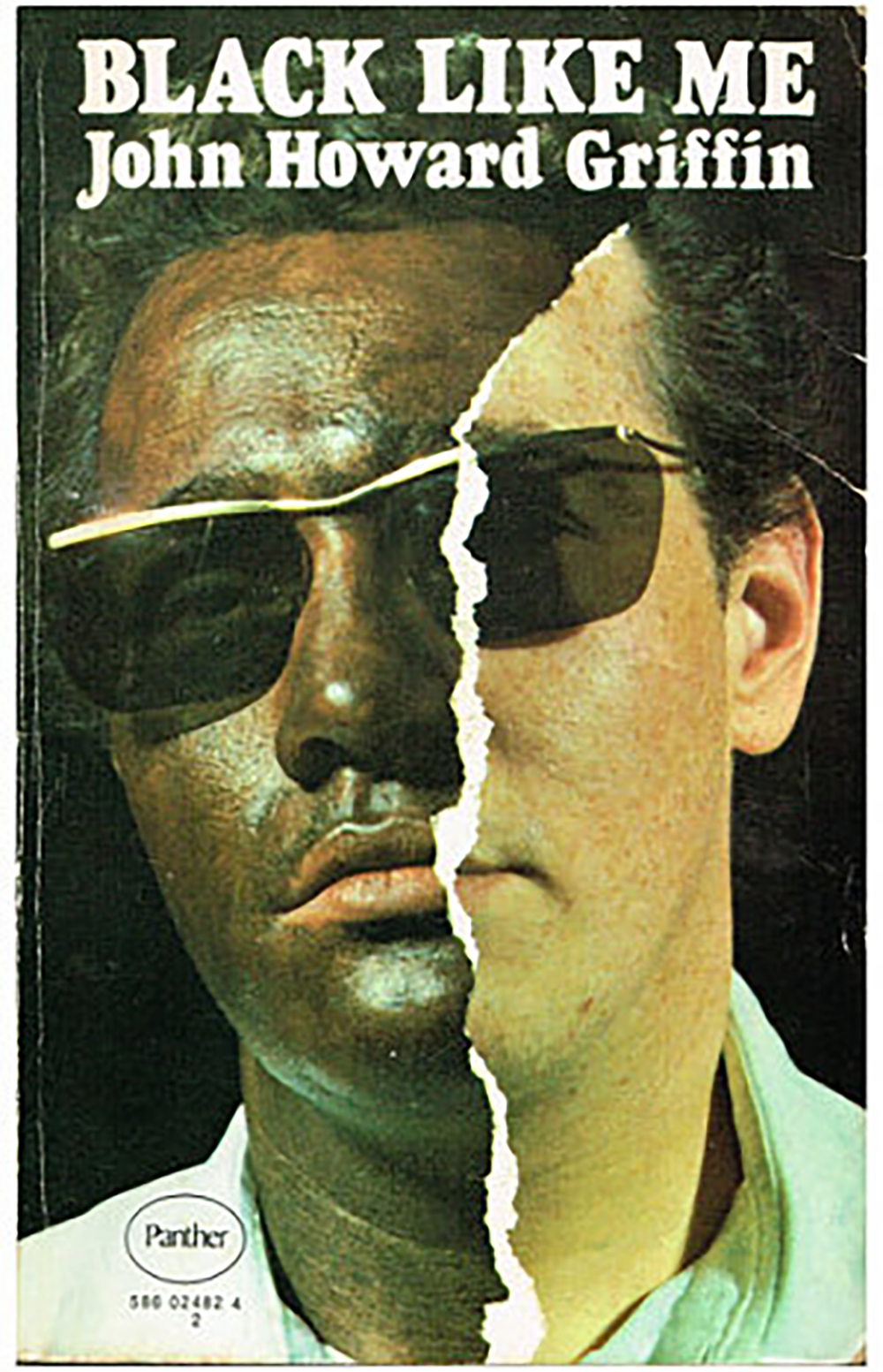
"Black like Me" – and him too: The parallel trails of John Howard Griffin and Ray Sprigle

Paperback cover for 20th printing
John Howard Griffin (born June 16, 1920) is famous for doing something that today sounds almost like a Candid Camera stunt: in 1959 he shaved his head and dyed his skin dark brown and then went through the South wearing a suit and tie, carrying a briefcase. He wondered if folks, simply on the basis of his skin color, would perceive him as a "Negro." And if the good citizens down there in New Orleans, Hattiesburg, Biloxi, and Montgomery did think he was a Negro, how would they treat him?
            
As you might imagine, not well. Jim Crow buses. "Colored" drinking fountains. "Whites Only" bathrooms, restaurants, churches, sidewalks, movie seats, hotels, park benches, and service. Obey or die. Fellow Negroes, seeing how confused and naive he was about southern customs, did all they could to shield this traveling stranger. One thing they could not protect him from, however, was the notorious "hate stare" beamed at him every time he said hello and dared to look at a white person.
            
Thirty days was about all Griffin could stand. The constant fear and disrespect put a rage in him he doubted he could control. He let the dye wear off and resumed his white identity. He'd gathered plenty of data from his semi-scientific experiment. He published his first reports in Sepia magazine, his sponsor.
Paperback cover for the non-subtle reader

Clamor and furor soon followed. Time magazine did a piece about him. He was interviewed on the Mike Wallace and Dave Garroway TVshows. His book, "Black Like Me," was published in 1961 and became a best seller. Also, a (mediocre) movie was released in 1964.
            
Now entrenched in the curriculum of many high schools and colleges, "Black Like Me" is considered to be a valuable tool for teaching American history and encouraging students to develop empathy for persons of color. African-Americans, by and large, see the book as a good book for white people to read. They're already living the experience, they say, so it's not news to them. Nonetheless, it has not been out of print since.
            
You have to wonder, though, what kind of man undertakes such an experiment? He was not a college prankster. He was 39-years-old, married, with children. A Texan. Some clues can be found in his past.
            
As a Texas teen he was awarded a scholarship to study music and literature in France, where he graduated from Poitiers University. Germany invaded France while he was there. Griffin took a quick study of medicine and joined the French Resistance as a medic at the French seaport of Saint-Nazaire. While there he also helped smuggle Austrian Jews to safety. Informed that the Nazis had put his name on their Kill List, he escaped back to America. In the States he immediately joined the Army Air Force and served for 39 months in the South Pacific. On one of his assignments he served as the only Caucasian on the Solomon Islands, charged with studying local culture. On his next assignment he was in combat when an explosion blinded him.
        
Back in the states, he began writing, despite his visual handicap.In 1952 he converted to Catholicism and became a lay Carmelite. In 1953 he married and fathered four children. In 1957 his vision suddenly, spontaneously, returned. Intensely philosophical and spiritual by now, he decided to undertake his experiment with skin color. After his book was published, praise and controversy followed. He was even lynched in effigy. In 1964, Griffin, along with John F. Kennedy was awarded a Pacem in Terris Peace and Freedom Award by the Davenport (Iowa) Catholic Interracial Council. Griffin's book will likely remain a classic of American
sociological literature.
           Strangely though, John Howard Griffin was not the first American journalist to darken his skin and travel though the South to write about Jim Crow. For years, Ray Sprigle, a Pulitzer Prize-winning writer for the Pittsburgh Post-Gazette had worn disguises and worked undercover, using the pseudonym James Crawford. He'd infiltrated coal mines, black market meat sellers, and state mental hospitals. In 1948, after browning his skin, he journeyed through Florida, Georgia and the Mississippi Delta. His series was titled, "I was a Negro in the South for 30 Days," and it ran in the Post-Gazette for 21 days. Throughout the series he wrote that, a black man's, "rights of citizenship ran only as far as the nearest white man said they did." The series was syndicated to 15 other newspapers, but appeared not at all in the South. In 1949 a book version of his experiences was published under the title, "In the Land of Jim Crow."
So, why is Griffin's book highly touted and Sprigle's hardly known? Several factors seem to be at work. For one, the United States was not ready to discuss racial prejudice, especially of the legal kind, in 1949. For another, television had not emerged as a means of publicizing an event or trend or idea. Griffin's sales were boosted enormously by the Time magazine story and his Dave Garroway & Mike Wallace TV show appearances.

Furthermore, though Sprigle's book is the superior work of journalism, compared to Griffin's, the latter's work reads like a novel or memoir. It is easier to identify with, since anyone can imagine what it might be like to look in the mirror and be alienated from his own image. Even its title, "Black like Me," provokes curiosity in a way that the objective-sounding "In the Land of Jim Crow" does not.


So, two men, similar journeys, similar tactics, similar trials, but one's book is still read today and the other's is a historical footnote. Sprigle was ahead of his time, but Griffin caught the rising wave of the future.

Sunday, June 7, 2015

Last night for 99-cent prices on all my Kindle books

Sunday evening coming on.

Last night to enjoy any/all of my Amazon e-Book titles for only 99cents. 


I'll change back to exorbitant tomorrow.


Buy here, click these words

Monday, June 1, 2015

A little pricing experiment with my Kindle books

Hello. Welcome to my writing blog. 

I'm curious to know what will happen if I change all my Kindle book prices to 99 cents. 

So I did. 

On Amazon. 

I'll try it for a week and see what the results are.

 Every little Kindle sale seems to matter a lot in my Kindle Top-100 rankings. 

So, I hope you try it and like it. 

All yours, HG    http://www.amazon.com/s/ref=nb_sb_ss_c_0_12?url=search-alias%3Dstripbooks&field-keywords=hugh+gilmore&sprefix=hugh+gilmore%2Caps%2C130