Just published: My Three Suicides: A Success Story...

Wednesday, April 10, 2013

Philip Roth has kindly stepped aside and offered you his place in line


President Obama removes Mr. Roth's medallion to make it ready for you...You!
Philip Roth, at 80, has announced his retirement from the literature scene, so there’s a big opening now for aspiring writers to jump through. Perhaps the gap would fit two or three new authors. Should now be the time for you, dear reader, to leap forward and stake your claim?

I imagine you might pause in fear and wonder what it would be like to assert yourself. To hurl your hopes into the great pond...perhaps only to hear a very small splash. One not as far from shore as you hoped? And you stand with your toes in the water, barely sensing a few faint ripples before the water stills. Could you stand that? How would you feel if you knew ahead of time that was all the reaction you would get? Would you go ahead anyway and try on Mr. Roth’s toga? Compose your song, or rhyme your poem, paint your canvas, or tap out your epic? Would it matter to you if you worked hard and all you got for it was the story, or poem, or song you created? Would you need a guarantee of monetary success, or an Oprah appearance before you started?

I was thinking those thoughts as I sat in my ponderer’s chair in the sunny living room this Saturday past. I was “killing” time (or should I say it was killing me?) as I sat waiting for the time when I’d need to jump up and rush to where I had to be. Time-wise, I live on the verge of late – as usual – but exactly on time – as usual. A compulsion towards punctuality is a great inducer of tension. Especially when one applies that notion to his career, his dreams, his life.

Where I was headed was Musehouse. That’s not a metaphor. It’s a literal place. But it works well as a metaphor also. If you don’t know it by now, that’s unfortunate, but not uncorrectable. The building stands at 7924 Germantown Avenue in the Chestnut Hill neighborhood of Philadelphia, but its essence lies in the loving hearts and minds of Kathy Sheeder Bonanno, the founder/director, and her wonderful staff of teachers and volunteers. Musehouse sponsors literary readings, including open mic nights, several times a week. They offer classes and workshops nearly every day (into the night). Most of all, they show care and openness toward all who want to say what is in their hearts through the medium of words, spoken or written.
            I was going there Saturday night, March 30, to be part of a celebration of the debut of The Musehouse Journal, Volume one, Number one. The journal is a juried magazine and the standards for selection were high. Many of the poets and prose writers who appeared in the magazine were there Saturday to read their selected pieces aloud. I was fortunate enough to be one of two story writers appearing in this inaugural issue. I would read a selection from a memoir I’ve nearly completed.

 I felt honored to be included, but worried that the sound of my stone in the pond would be lost amidst the plunks of so many others. And I wondered who would ever read the journal after Saturday night. And I worried that what I had written was too personally revealing. And I suspected that my speaking voice could never do justice to the emotions I wrote about – four short scenes from my childhood. I had rehearsed with a tape recorder numerous times in the previous days, but the playbacks never sounded like the voices I heard while writing the story. Did that matter? A writers’ words have to do the magic on their own. I guess. In my case, perhaps not, but one of my favorite quotes is Machiavelli’s “fortune favors the bold.”

 I’ve been talking about myself, last Saturday night, but still haven’t forgotten those of you who want to write but don’t have time. Those who want to speak, but don’t know if they’ll ever find the words. Those who wonder, What’s the use? Reasonable questions. But....

Well, if you were expecting the Big Reveal here, there isn’t one. If you feel you have something to say, just go ahead and write it down. There’s no reason not to.

If you need a guarantee: the only certain one is that you’ll certainly get nowhere if you don’t start. Of course, there’s no guarantee you’ll “get anywhere” if you do. But is that what you want to unlock your heart for? Riches? Is that why you have lived as long as you have, and survived the awful things you’ve seen and heard? Fame? Or the beauties you have witnessed and never given word to before? Listeners? Oh, well, that’s a different matter. That might be worth while.

I sat there on my folding chair Saturday night, waiting my turn, thinking as each person came up to the microphone: My goodness, you never, ever, can predict what another person is carrying around in his/her, heart. Or the experiences they’ve had. Such surprises I heard.
            
When my turn came, I felt like I was offering my part in a collective prayer against those imagined gods who wait to mock our hopes and dreams.
             
Thank you, Kathleen Sheeder Bonanno, Musehouse, and my fellow writers from Saturday night.


Musehouse is easily Googled. I'm now on Facebook. My latest book, the quirky romance/twisted family story of “Last Night on the Gorilla Tour” is available in both ebook and paperback formats on Amazon.com.


Thursday, March 28, 2013

It was the best of times? It was the worst of times?


I find great comfort in knowing that shitty things happened in every generation, not just ours.
                                                                  by Hugh Gilmore


Do you get old-classmate emails describing how everything was rosy back in our day and everything stinks now? 

I do, and I find them unbearably smug, defensive, and wrong-headed. Pardon my French, but why is that that the older people get, the less history they know?

Fed up with the modern age? You need only open a crusty old gazette from an other era and your blood pressure will simmer down and you’ll be able to breathe again. If you read a few old newspapers you’ll see that the Good Old Days weren’t so good and the bad new days aren’t so bad.

Here, let’s take a look. On my desk right now, a randomly chosen sample: The Prescott (AZ) Evening Courier for Monday, January 9, 1933. By the way, I’m not lookin at an old digital file on the internet. In my used-book business, I often come across old magazines and newspapers. 

 Unlike today’s newspaper layouts, the Courier’s 18-inch-wide page one contains both big and little stories, of local, national and international interest. Among the eternal verities, we find: “Flagstaff Man Murders Wife” (handgun used during family quarrel); “2 More French Boats Disabled” (passenger boats catch fire and have to be towed to port); “Indict Meeker In Bank Case” (president of defunct bank indicted for fraud); “7th of Town’s Folk Have Typhoid Fever” (This, actually, from nearby Chamberlain, S.D.); “4 High School Players Killed” (after basketball game, head-on collision at night, one headlight not working); “Congressman is Dead, Suicide” (Republican Congressman from Pennsylvania, Samuel Austin Kendall, unable to overcome grief at the loss of his wife, shot himself with pistol in his office). And from Napa Valley, CA: “Roger Sprague, former university professor who went insane on the Berkeley campus in 1919 and shot and wounded two college officials, laid his head deliberately on the tracks of the Napa Electric Railway today and was decapitated.”

 These stories were laid out side-by-side with such tidbits as a parking ticket given to an elephant, a two-headed turtle that “couldn’t make up its mind,” the Premier of North China offering a truce to Japan, with whom it had been fighting quite a while, President FDR meeting with Stimson, and a veterans group (WWI) still fighting Congress for aid to veterans.

Inside the paper, as eternal consolation, you’ll find the sports and entertainment pages. In one column Connie Mack of the Philadelphia Athletics Baseball Club blamed the recent sale of Al Simmons, Jimmy Dykes, and “Mule” Haas to the Chicago White Sox on Philadelphia’s Blue Laws, which did not allow Sunday contests. Speaking at The Holy Name Society of St. Jean of Arc Catholic church, he said the loss of revenue left him unable to pay the players’ wages.
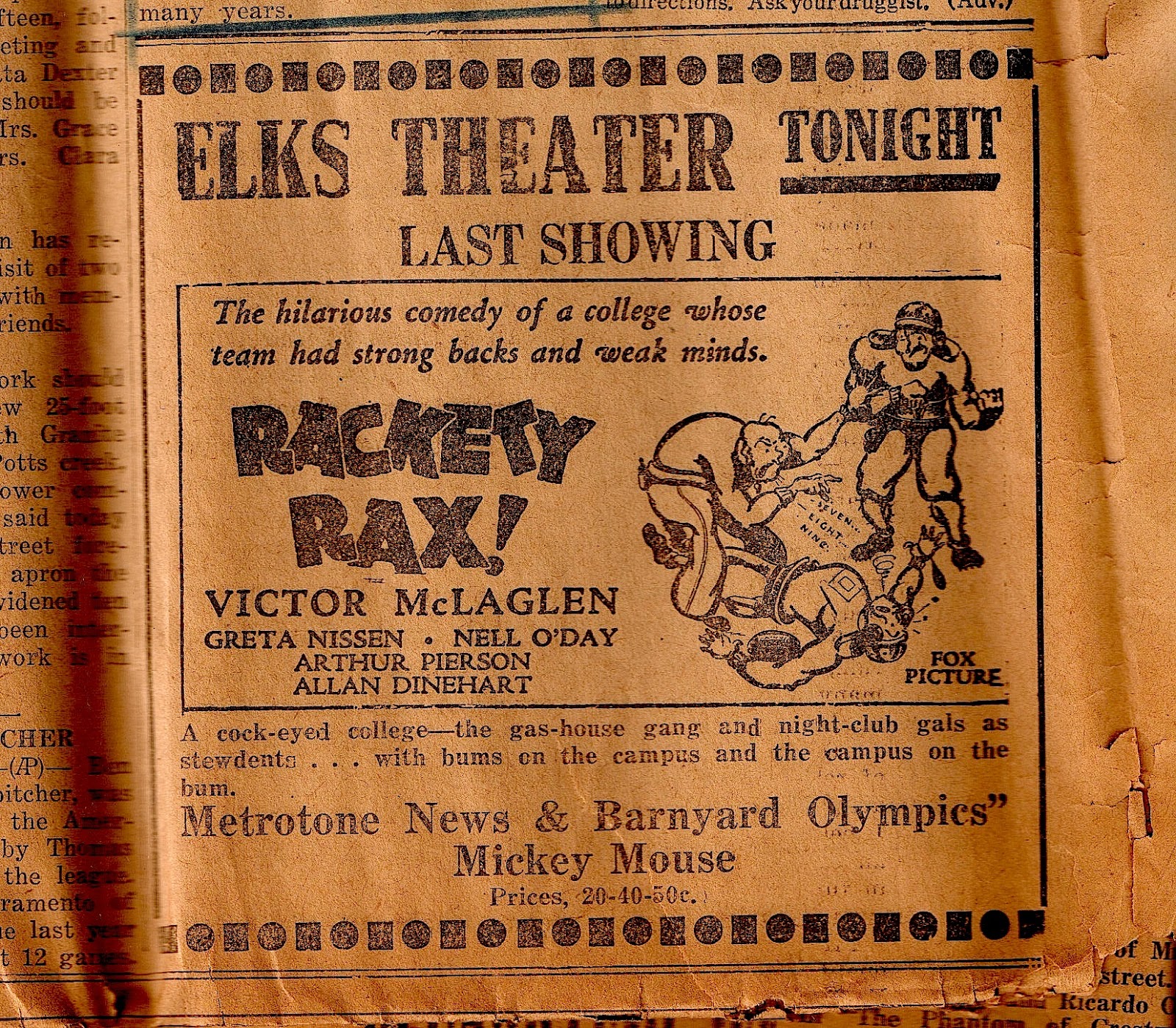
On the plus side, the new movie “Rackety Rax,” with Victor Mc Glaglen and Greta Nissen was described as a laugh riot. 

 Oh my, you might think, but those stories were out of Prescott, Arizona, and everything’s a bit strange west of the Schuylkill River. Granting you that possibility, I pick up the Philadelphia Evening Ledger for Wednesday, July 26, 1937. The banner headline reads “THOUSANDS FALL IN BATTLE OF PEIPING.” The Japanese army continued its assault on China. Under the banner, two columns by 10 inches, you’ll find the day’s baseball scores. (Phillies lose to Pittsburgh, 6 – 4; A’s losing to Cleveland, 6 – 5).

In Belfast, Ireland, bombs, arson, and gunfire greeted King George VI and Queen Elizabeth as they toured. Fumes forced employees of the 7-UP bottling company at 817-19 Carpenter Street to flee with handkerchiefs pressed to their noses.

Camden’s Director of Public Works, Frank J. Hartmann, declared war on crickets in the neighborhood of 10th and Vine. Neighbors were finding crickets in their hair, bathtubs, and beds. Hartmann threatened to bury the crickets with an asphalt parking lot “if we have much more trouble.”

A policeman from the 69th and Dicks area got paid on Friday and failed to return home or show up for work on Monday. A boy drowned in Pennypack Creek. 

“15 Horses Saved in Cemetery Fire” The cemetery was Holy Sepulchre near Easton Road in Glenside. On the cemetery grounds were two shacks – one kept as a chicken coop and the other as a pheasant house. These tarpaper lean-tos caught fire and sparks flew over to set the roofs of the stables at Gramm’s Riding Academy of Glenside on fire. “William Wardell, a Negro stableman” and two boys, Arthur Hammarlund and Robert Fisher helped to rescue the horses. (This news item chosen apropos the running controversy lately about racial identification of newsworthy people.)

You’ll find similar stories in every edition of every uncensored newspaper in the world, no matter what era the paper is from, including the Holy American Era when our Founding Fathers bestrode the earth. My point today being simply: please stop sending me funny, wise nuggets about how wonderful the old days were. I’m with Benjamin, the mule in Orwell’s “Animal Farm,” quotable for saying, “Life will go on as it has always gone on – that is, badly.”
            That doesn’t mean I don’t like people. I do. I have a tremendous sympathy for my fellow mortals. Nor does it mean I’m a pessimist. I’m not. But, boy, people sure don’t learn easily.


Friday, March 15, 2013

Living the Walter Mitty Life ... Pocketa Queep

But I'm NOT living the writer's life for them. I'm doing it for myself.
  
I need to talk to you this week as though we’re meeting for coffee, and I have to catch you up on a thousand and one things that have happened since we last had a heart-to-heart. 

    I had my book launch for “Gorilla Tour,” as I’ve come to call it, and that went very well. Kathy Bonanno, founder/director of Musehouse Literary Center, 7924 Germantown Ave., and her staff run a smooth operation. I had a full house for my reading and sold some books and had a number of interesting conversations with people as we all stood around cheese-and-crackering (and wining) later.

More than one person told me that I stand as a figure of inspiration. I think they meant, “If a dummy like you can get a book launch, then there’s hope for the rest of us.” Meaning: other writers who haven’t finished their books, or haven’t felt that magical moment where they feel they should take their manuscript out of the drawer and start trying to market it. A friend told me that I’m kind of living a Walter Mittyish existence where I live out other people’s dreams.
Perhaps so, but it’s not a risk-free existence. The day of the book launch someone shared with me an email sent by another person that said, in effect, “I wasted money on his first book, “Malcolm’s Wine,” which I found unreadable. Now I don’t want to go to his reading and buy another unreadable book.”
“Ha ha ha,” I said, pulling the needle from my arm and emerging from the men’s room, “Everyone’s entitled to his own opinion.”

Tuesday, March 12, 2013

What's your Relationship to Your Personal Library


                                                    Do you have a personal library?

I would imagine that anyone who reads this blog regularly would have a collection of books he or she keeps around. I do. Why do we keep them around? In my case, I am not much of a rereader. Yet many of my books, even ones I’ll probably not even open again, and even forget I still have, I will never part with. Sometimes I’ll happen on one of them when taking down some other book. I’ll remember how old I was when I found it. And where. And sometimes even the way the sun slanted through the shop window when I first saw it. I remember also the joy, or relive the shock, or suffer still the sorrow I felt when I first read it.

Friends and loved ones have come and gone in my life, many of them as wrenching losses, others as luminous additions, but through it all my books alone have known me and stood beside me. They’ve lived through every one of the varied addresses I’ve known over several decades. To lose this book, or that, would be to lose my only link to the memories of who I used to be at that time of my life. No other object could possibly launch those precious memories for me.

            As I stand facing my shelves of books, I sometimes wonder at their cumulative power in stating who I am. They reflect the neural pathways of my brain. Taken together they represent my mind. I have no overriding arrangement to the order of the books on my shelves. If I have many on one topic, they’ll probably stand together.

        But just suppose I placed them in the order in which I read them. Couldn’t I then trace along the shelves the evolution of myself as a thinking person? And not just my ideas, but couldn’t I also trace the history of certain subtle emotions as they arose and grew and took shape in my heart? And if that is true, that I could trace the history of my heart, and my mind, is there a point at which my moving finger could stop and I could say: “There, this is where I became who I am”?

            Would it be the most recent book I read and placed there? Or did I fundamentally become the person I am some time long ago, and all the additons are merely accentuations?

            Such heady stuff.

Friday, March 8, 2013

Richard Brautigan in 9000 clicks


One of Brautigan's many personae

                                 by Hugh Gilmore

            What an ordeal. I just finished a very long, tedious, but quite fascinating book whose final, inevitable paragraphs made me quite sad. Once I committed to writing about it, I felt like saying, "I am Lazarus, come from the dead/Come back to tell you all, I shall tell you all...” (after T.S. Eliot’s  “Prufrock”). Though I’m not sure that I can.

The book is William Hjorstberg’s 880-page biography-down-to-the-last-scrap-of-paper, “Jubilee Hitchhiker: The Life and Times of Richard Brautigan.” It was originally published around this time last year. It took me three weeks of daily reading to finish this book. And I never particularly cared for, nor was interested in Richard Brautigan, as poet, novelist, icon or man. And to make matters harder, I read the book on my Kindle.

Do you know what it is like to read an 880-page book on a Kindle? For one thing, the “page” is too small and confining. More importantly, without the benefit of turning a page and seeing a higher page number that helps you mark your progress, the process seems endless. A Kindle indicates the percentage of the total you’ve read so far. To move 10% you must page-click the word equivalent of 88 book pages. At the font size I used, it took about 10 clicks to move 1 %. Close to 900 clicks to move through 10 percent of the book. Two weeks into the book, though I was enjoying it immensely, I wished I were done. I was at 40%. I started pushing. I read at all hours of the day. Last Saturday night I finished. And I was quite sad about how it ended.